How COP30 Went Up in Flames and Revealed the Brutal Truth About Who’s Really Destroying the Amazon
written by Jan Vranken.
BELÉM, BRAZIL — When I heard that fire had broken out at COP30 on Thursday afternoon, my first thought — and I’m not proud of this — was: Could the Indigenous protesters have done this? After days of blockades, confrontations with security, and two guards injured in scuffles, had things escalated? Had desperation turned to sabotage?
Then I read further. A generator failure near the China Pavilion. A short circuit in a hastily constructed booth. The flames tearing through canvas pavilions that were still being hammered together while world leaders gave speeches inside. Not arson. Not protest. Just incompetence.
And that’s when it hit me: The real savages in this story aren’t the Indigenous peoples who’ve sustainably managed the rainforest for millennia. The real savages are us — the 50,000 delegates, journalists, and diplomats who flew to the Amazon to talk about saving the Amazon, while we hacked a four-lane highway through protected forest to get there more conveniently.
THE CONFERENCE THAT BECAME A CRIME SCENE
Let’s talk about what COP30 really was. Not a climate summit. A crime scene.
More than 50,000 people descended on Belém, a city on the edge of the world’s greatest rainforest, leaving carbon footprints the size of small nations. To accommodate this cavalcade of virtue signaling, Brazilian authorities fast-tracked construction of Avenida Liberdade — “Freedom Avenue,” in a cosmic joke — carving a four-lane highway through protected Amazon rainforest. The forest protection conference required destroying forest. You can’t make this up.
The venue itself was a monument to rushed desperation. A former airfield converted into the Hangar Convention Centre, still under construction as delegates arrived. Journalists reported exposed beams, open plywood floors, metal corridors leading nowhere. During pre-summit events, the sound of jackhammering and drilling punctuated speeches about environmental stewardship. Workers in hardhats scurried past dignitaries in suits.
Then came the rain. Torrential tropical downpours leaked through the roof, soaking meeting spaces. Water dripped on delegates discussing drought mitigation. The air conditioning struggled against the heat and humidity. Toilets failed. Food ran short. Simon Stiell, the UN climate chief, wrote a desperate letter flagging security concerns, malfunctioning systems, and rainwater seeping into lighting fixtures.
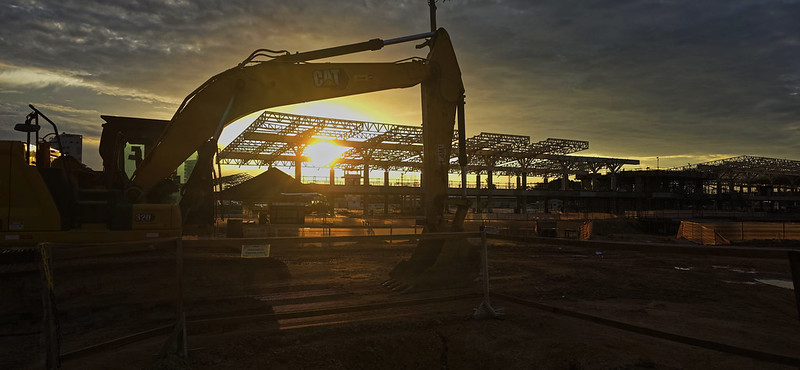
“work in progress, COP30 Belem Para Brazil” by tongeron91 is licensed under CC BY-SA 2.0. To view a copy of this license, visit https://creativecommons.org/licenses/by-sa/2.0/?
One volunteer, Gabi Andrade, had worked accreditation for three weeks. Thursday was her first free afternoon. She was exploring the Singapore pavilion when she saw black smoke. A security guard grabbed her hand, shouting “fire,” and pulled her toward the exit. As she evacuated, crying, one thought consumed her: “What will this mean for Brazil’s reputation?”
But Brazil’s reputation was already in flames. Literally.
THE WARNINGS WE IGNORED
Here’s what happened in the days before the fire — the warnings we refused to hear.
November 11: Dozens of Indigenous demonstrators forced their way into the COP30 venue, clashing with security at the main entrance. They carried signs reading “Our land is not for sale.” Tables and chairs became barricades as UN personnel tried to push protesters back. Two security guards suffered minor injuries — one hit in the head by a heavy drumstick from the protest, another clutching his stomach after being struck.
“We can’t eat money,” said Gilmar, an Indigenous leader from the Tupinamba community, who uses one name. “We want our lands free from agribusiness, oil exploration, illegal miners and illegal loggers.”
The UN issued a terse statement about “minor injuries to two security staff and minor damage to the venue.” The protesters were dispersed. The conference continued.
November 14: About 100 Munduruku Indigenous people blocked the main entrance for 90 minutes in a peaceful human chain. “No one enters, no one leaves,” they chanted. Brazilian military personnel stood guard, but there were no physical altercations this time.
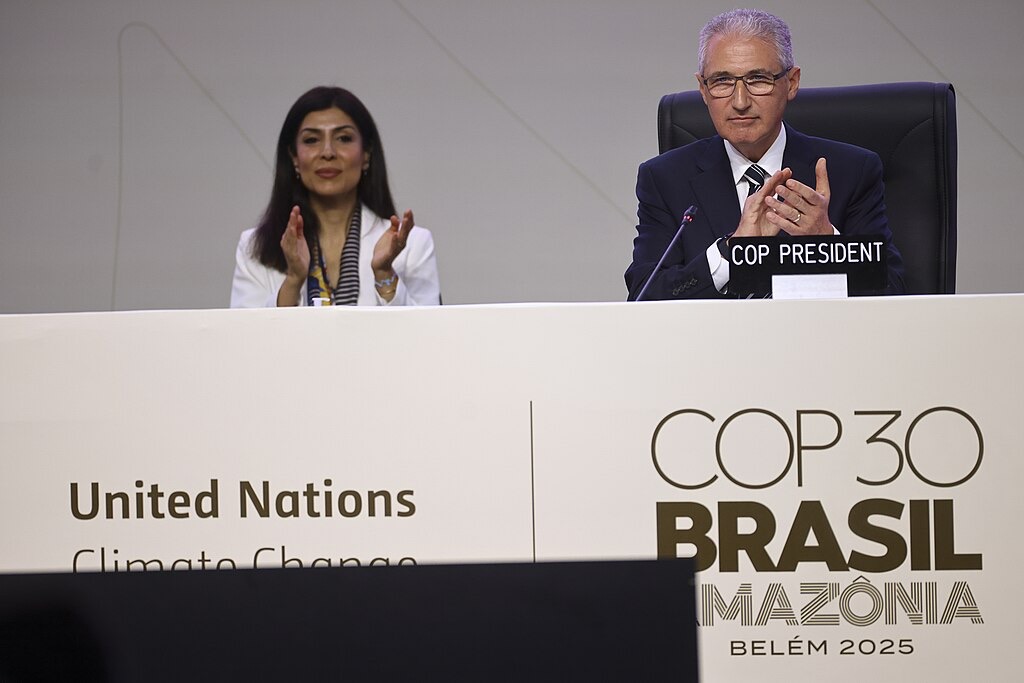
COP30 president André Corrêa do Lago, a veteran diplomat, came out to meet them. Photographs show him cradling a protester’s baby in his arms, smiling and nodding as he talked. After prolonged discussions, the group moved away from the entrance together. The blockade lifted.
Their demands: Revoke plans for commercial river development. Cancel a grain railway project threatening deforestation. Demarcate Indigenous territories clearly. Reject carbon credits based on their land. Meet with President Lula.
“President Lula, we are here in front of COP because we want you to listen to us,” they said.
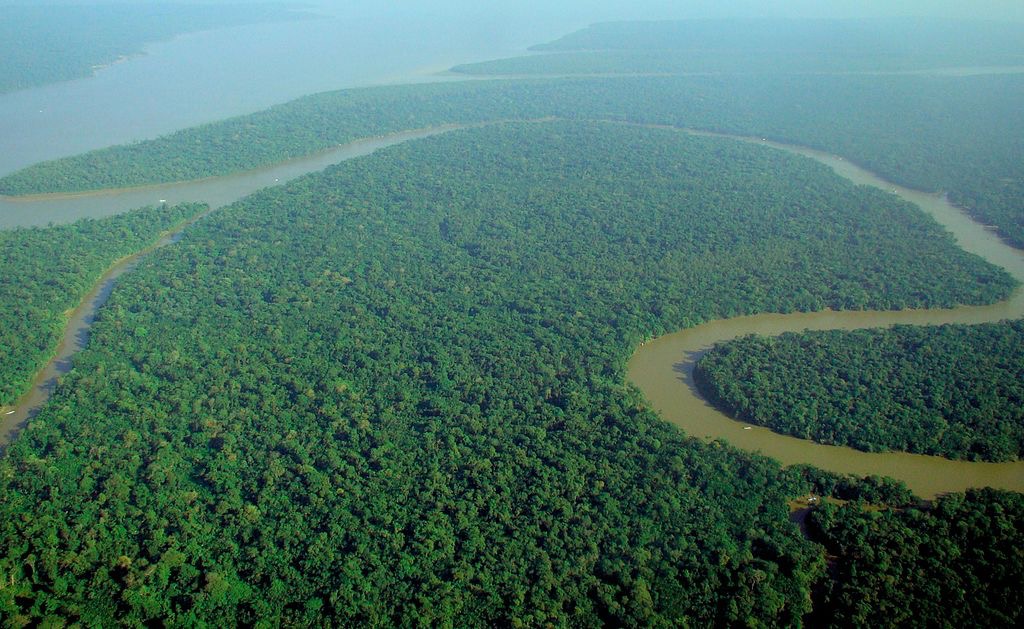
“Aerial view of the Amazon Rainforest” by lubasi is licensed under CC BY-SA 2.0. To view a copy of this license, visit https://creativecommons.org/licenses/by-sa/2.0/?ref=openverse.
November 15: Tens of thousands marched through Belém in the “Great People’s March” — a massive demonstration that unfolded in festive atmosphere. Protesters carried a giant beach ball painted like Earth, a Brazilian flag emblazoned with “Protected Amazon,” and Palestinian flags. They danced to pounding speakers under the searing sun.
“Today we are witnessing a massacre as our forest is being destroyed,” said Benedito Huni Kuin, a 50-year-old member of the Huni Kuin Indigenous group. “We want to make our voices heard from the Amazon and demand results. We need more Indigenous representatives at COP to defend our rights.”
Youth leader Ana Heloisa Alves, 27, told reporters: “This is incredible. You can’t ignore all these people.”
But we did ignore them. The conference continued behind military lines.
November 20: At 2 p.m., fire broke out near the China Pavilion. Within minutes, flames consumed the canvas structures, burning a hole through the roof. Emergency crews rushed in with extinguishers. Smoke engulfed corridors. People screamed “fire” and ran for exits. A siren that didn’t exist sent delegates scrambling with their laptops and briefcases.
The blaze was contained within 30 minutes. No casualties. Just a building full of climate officials evacuated from a burning structure, while the forest they claimed to protect burns at a rate 117% above historical averages.
The metaphor wrote itself. While Indigenous peoples warned us about fires in their forests, the building where their future was being decided caught fire.
If that’s not a sign, what is?
WHO ARE THE REAL SAVAGES?
Let me show you a tale of two peoples.
The Indigenous peoples of the Amazon:
- Have sustainably managed their land for thousands of years
- Between 1985 and 2020, just 1.2% of vegetation was lost in Indigenous territories
- Meanwhile, 90% of all Amazon deforestation occurred outside Indigenous lands
- Their forests are net carbon sinks: removing 460 million metric tons of CO2 annually while emitting only 120 million
- That’s a net removal of 340 million metric tons per year — equivalent to the United Kingdom’s entire annual fossil fuel emissions
- They live in balance with the ecosystem, as their ancestors did before them
Us — the “civilized” ones:
- Have cleared 20% of the Amazon in just a few decades
- Flew 50,000 people to a climate summit (carbon emissions: massive)
- Hacked a highway through protected forest for “accessibility”
- Built failing infrastructure that literally caught fire
- Approved Petrobras oil drilling near the mouth of the Amazon River during the climate conference
- Signed the “Devastation Bill” weakening environmental protections right before COP30
- Talk about “carbon credits” while the forests burn
- In 2024 alone, 15.6 million hectares of Amazon burned — an area larger than the entire Netherlands
- In 2025, deforestation is up 27% in the first six months, with 51% occurring in recently burned areas
The feedback loop is active. The tipping point approaches.
Thirteen percent of the Amazon has been degraded or destroyed. Scientists warn that at 20-25%, the transformation from rainforest to savanna becomes irreversible. We’re 7-12 percentage points away from planetary catastrophe. The Amazon already absorbs 25% less CO2 than it would without climate impacts. Some areas are now net emitters rather than absorbers.
So who’s wild here? Those protecting the forest as their ancestors did for millennia? Or those who fly in by the thousands, hack roads, drill for oil, and act surprised when everything goes up in flames?
THE SYMBOLISM OF LULA’S CHOICE
I understand why President Luiz Inácio Lula da Silva wanted to hold COP30 in Belém. The symbolism is powerful: bring the world to the edge of the Amazon, put their noses in the facts, give Indigenous peoples a platform.
But what did we learn? That you can’t “use” the Amazon for symbolic purposes without damaging it. That’s exactly the problem. We see the rainforest as a means, as a resource, as backdrop for our conferences and our economy. Indigenous peoples see it as life itself.
During the summit, while delegates debated carbon markets in air-conditioned rooms, Brazil’s state oil company Petrobras received permits to begin exploratory offshore drilling near the Amazon’s mouth — just hundreds of miles from the conference venue. While ministers promised zero deforestation by 2030, the “Devastation Bill” gutted environmental licensing requirements for projects that could accelerate forest clearing.
Lula himself highlights Indigenous communities as “key players” in negotiations while industrial and development projects continue encroaching on their lands. He proclaimed COP30 would be “inspired by Indigenous peoples and traditional communities — for whom sustainability has always been synonymous with their way of life.”
But inspiration isn’t protection. Poetry isn’t policy.
Germany’s Chancellor Friedrich Merz visited earlier in November and, upon returning home, told a Berlin trade conference he was “happy to leave” Belém and return to his country’s “prosperous and free environment.” Brazilian officials erupted. Rio’s mayor called Merz a Nazi before later deleting the posts. President Lula fired back: “He should have gone to a pub, he should have danced, he should have tried the food. He would notice that Berlin doesn’t give him 10% of the quality offered by Pará state.”
But Merz’s contempt was just more honest than the rest. At least he admitted what most delegates felt: that the Amazon and its people are backward, primitive, obstacles to progress. At least he didn’t pretend that flying 50,000 people into the rainforest to discuss rainforest protection made sense.
The fire at COP30 is the ultimate warning: even with the best intentions, we destroy what we touch. The Amazon isn’t our stage. It’s not our oil field. It’s not our highway. It’s their home — and they’re the only ones who know how to protect it.
WHAT NEEDS TO HAPPEN NOW
The scientific consensus is crystal clear. The clock isn’t ticking — it’s screaming.
Thirteen percent of the Amazon is already degraded or destroyed. We’re between 7-12 percentage points from the irreversible tipping point where the forest transforms into savanna. The absorption rate has dropped 25%. Some regions are now net carbon emitters. In the first half of 2025, deforestation jumped 27%, with more than half occurring in recently burned areas. The feedback loop — drought leads to fire leads to more drought — is active and accelerating.
In 2024, the Amazon experienced the largest burned area since monitoring began in 1985. Record heat and exceptional drought turned wide stretches of humid interior forest into tinder. When agricultural burns escaped control, 15.6 million hectares went up in flames, releasing as much CO2 as Canada emits in a year.
MapBiomas, a Brazilian monitoring platform, reported that fires now play a larger role in forest loss than direct clearing. Degradation from logging, roads, and fragmentation, combined with hotter and drier conditions, has created a new and more dangerous pattern of destruction.
“We are reaching a point where climate change is beginning to endanger the very solutions we are proposing,” said Joice Ferreira, a Belém-based researcher at the Brazilian Agricultural Research Corporation.
The solution exists. We just refuse to implement it.
Here’s what actually needs to happen:
1. Recognize Indigenous land rights immediately and fully. This is the single most effective climate action available. Current Indigenous lands and protected areas will prevent an estimated 4.3 million hectares of deforestation between 2022 and 2030, avoiding 2.1 gigatons of CO2 emissions — more than Russia’s annual carbon output. Expanding protection to currently vulnerable areas would prevent an additional 2.5 million hectares of deforestation and reduce emissions by another 1.2 gigatons by 2030.
2. End all extractive industries in the Amazon basin. No oil drilling. No gold mining. No large-scale cattle ranching. No soy plantations. If it destroys forest, it stops. Now.
3. Cancel all infrastructure projects through protected areas. No roads. No highways. No dams. The Avenida Liberdade disaster should be the last time we pave paradise.
4. Massively fund Indigenous communities directly. Not carbon credit cowboys. Not corrupt middlemen. Direct funding to the people who’ve proven they can protect the forest. Between 2001 and 2021, Indigenous territories were net carbon sinks while being home to communities that need economic support.
5. Let Indigenous peoples manage their own forests. They’re already doing it 90% better than we are. Get out of their way.
Harjeet Singh, a veteran anti-fossil fuel activist, watched the Indigenous blockade and said what everyone should understand: “We should look at this as a message and signal from Indigenous people, who have not seen any progress over the past 33 years of COP, that all these conversations have not led to actions. They are the custodians of biodiversity and climate and clearly, they are not satisfied with how this process is doing.”
Paolo Destilo, with the environmental group Debt for Climate, joined the human chain encircling protesters. “This is worth any delays to the conference,” he said. “If this is really to be Indigenous peoples’ COP, like officials keep saying, these types of demonstrations should be welcomed at COP30.”
But it wasn’t their COP. It was never going to be their COP. It was ours — another conference, another carnival of greenwashing, another opportunity for rich nations to make promises they won’t keep while the people who actually protect the planet beg to be heard.
THE SIGN WE REFUSE TO READ
The fire at COP30 wasn’t an accident. It was a sign. A warning. A metaphor that refused to stay subtle.
While Indigenous peoples begged to be heard about fires in their forests, the building where their future was being decided caught fire. While delegates debated carbon markets, flames consumed the canvas pavilions. While security pushed back Indigenous protesters demanding action, generator failures and short circuits revealed the fragility of our rushed, improvised solutions.
They aren’t the savages. We are.
Every instinct of our civilization — our reflex to extract, to develop, to monetize, to conference about rather than act upon — led to this moment. We cleared protected forest to drive to a forest protection summit. We built failing infrastructure to house negotiations about preventing failure. We ignored the people with solutions so we could keep talking about problems.
The Munduruku, Huni Kuin, Tupinamba, and hundreds of other Indigenous groups don’t need more conferences. They need their land rights recognized. They need extractive industries expelled. They need the rest of us to do something radical: nothing. Leave them alone. Let them protect what they’ve always protected.
Ana Toni, CEO of COP30, said the protests were “legitimate” and that “the purpose of holding a conference in the Amazon is precisely to listen to these demands.”
But we didn’t listen. We never listen.
We’ll write our reports. We’ll update our Nationally Determined Contributions. We’ll pledge carbon neutrality by 2050, 2040, 2030 — pick a date, any date far enough away that we won’t be held accountable. We’ll fly home, congratulating ourselves on another successful negotiation, while the Amazon burns at record rates and Indigenous peoples prepare for the next protest that will be ignored.
The Amazon doesn’t need us to save it. It needs us to get the hell out of the way.
Gabi Andrade, the volunteer who fled the fire in tears, worried about Brazil’s reputation. But Brazil’s reputation — and ours, and the planet’s — burns every time we choose to talk instead of act, to conference instead of defer, to manage instead of respect.
Until we recognize that truth — until we stop pretending our solutions aren’t the problem and start empowering the people who’ve been protecting this forest for thousands of years — everything we touch will go up in flames.
The fire at COP30 was never about a generator failure or a short circuit. It was about what happens when civilization itself short-circuits, when our arrogance meets our incompetence, when our words collide with their consequences.
The Amazon is burning. COP30 burned. The message couldn’t be clearer.
Let the real protectors do their work. And take your hands off.
 Writerz Block
Plaats een reactie