Three Sons, Three Fates, and the Impossible Mathematics of Musical Legacy
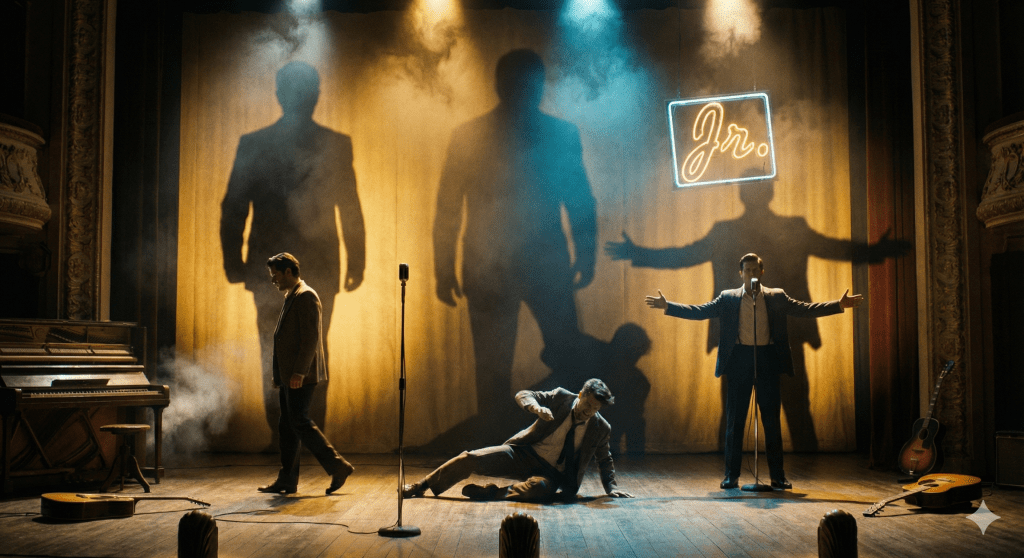
THE WEIGHT OF THE NAME
Three Sons, Three Fates, and the Impossible Mathematics of Musical Legacy
By Jan Vranken
The EDM drop hits at exactly one minute and six seconds into “Der Kleine Trommler,” Art Garfunkel Jr.’s techno-schlager reimagining of “The Little Drummer Boy,” and for a moment I genuinely wonder if I’m having a stroke. Four-to-the-floor kicks. Sidechain compression. Deep house synths that sound like they were ripped from a 2012 Ibiza compilation. The “bom-bom-bom” backing vocals have been processed through so many effects that they sound less like angels heralding the birth of Christ and more like malfunctioning Roombas crying out for help.
I’m sitting in my home office in Beek, Netherlands, reviewing Advent, the new Christmas album from a man who legally changed his name to add “Jr.” to the end, just to make absolutely certain you understood whose son he is. This is the third—third—album of his I’ve been assigned to review, each one a fresh circle of musical purgatory, each one forcing me to confront an increasingly uncomfortable question: What happens to the children of legends?
It’s a question that’s been gnawing at me through years of music journalism. Some of these legacy kids become legends themselves. Some quietly carve out respectable careers in their parents’ shadows. And some—God help them—make EDM Christmas albums in Germany while dragging their 83-year-old fathers into the studio to prove they’re legitimate.
This is a story about three sons. Three different paths. Three different answers to the same impossible question: How do you become yourself when your name has already been someone else?
ACT I: THE ESCAPE ARTIST
A.J. Croce, or How to Outlive Your Father’s Ghost
Jim Croce’s professional music career lasted exactly eighteen months. Eighteen months of dues-paying in coffee shops and bars culminated in a white-hot streak of hits in 1972-73: “Bad, Bad Leroy Brown,” “You Don’t Mess Around with Jim,” “Time in a Bottle,” “Operator.” Then, on September 20, 1973, a small charter plane crashed in Louisiana. Jim Croce was thirty years old. His son, Adrian James—A.J.—was two.
Actually, he was one week away from turning two, but who’s counting? Well, A.J. is, probably. When your father dies before you have memories of him, you count everything. Every home recording. Every photograph. Every story from people who knew him. Every song in his record collection that might tell you who he was.
Here’s what A.J. Croce didn’t do: immediately capitalize on that name. At sixteen, he was already being asked to record an album of his father’s songs. He refused. “I didn’t feel there was integrity in just playing my dad’s stuff,” he explained decades later, his voice carrying the patient tone of someone who’s answered this question a thousand times. “I wanted my own identity as a musician.”
But let’s back up, because A.J.’s story starts in an even darker place. At age four—still years before he could have formed memories of his father—he lost his vision after suffering physical abuse at the hands of one of his mother’s boyfriends. Blind for six years. Hospitalized for six months. The kind of tragedy that would have broken most people.
Instead, he learned piano by ear. Inspired by Ray Charles, Stevie Wonder, Blind Blake, Blind Willie McTell—the blind musicians in his father’s record collection became his guides. By fifteen, he was gigging in bands. By twenty-one, he was touring with B.B. King and Ray Charles. By the time most of us are figuring out what we want to do with our lives, A.J. Croce had already built one.
Ten studio albums over thirty years. Not one of them trading on his father’s name. Not one duet where daddy’s ghost was wheeled out to add legitimacy. Just A.J., his piano, and a virtuosic mastery of American roots music—blues, soul, jazz, New Orleans funk. He became a musician’s musician, the kind of artist other artists respect.
But here’s where the story gets eerie, in a way that makes you wonder about genetics and memory and whether talent really can be inherited. In his thirties, A.J. was digitizing his father’s old tapes when he found a recording of Jim playing a bar set—obscure blues songs, deep cuts, the kind of material only serious diggers know. Songs like Fats Waller’s “You’re Not the Only Oyster in the Stew.”
“These were songs that I had performed since I was 13, 14, 15 years old,” A.J. said, still sounding amazed decades later. “Old blues songs that were really obscure, jazz, blues, old rock ‘n’ roll, old country. It wasn’t just the same artists—it was the same, exact songs.”
The same songs. Songs he’d discovered independently, never knowing his father had played them too. Some weird genetic echo across time, the same ears hearing the same beauty in the same forgotten corners of American music.
That discovery changed something. Not immediately—A.J. still had too much respect for both his father’s legacy and his own hard-won identity to rush into anything. But slowly, the idea of “Croce Plays Croce” began to make sense. Not as a desperate grab for relevance, but as a genuine connection to something larger than himself.
In 2019, at age 52—twenty-two years older than his father ever got to be—A.J. finally debuted the tour. His own songs mixed with his father’s hits, played on the same vintage Gibson acoustic his mother had saved for him. The guitar his father had played. And something happened that he didn’t expect.
“All the fear I had of trying to live up to some expectations—and the fear of comparisons with my father—evaporated,” he said. “People were coming to see me because they knew me as a musician and a performer. I become this three-dimensional personification of their memory of nostalgia.”
Read that last line again, because it’s the key to the whole thing: three-dimensional personification. Not an imitation. Not a cover band. Not a desperate kid clinging to daddy’s coattails. A real artist who earned the right to play those songs by first becoming someone completely different.
He waited twenty-five years. Twenty-five years of building his own career, his own voice, his own damn identity. Only then—when there was no question who A.J. Croce was—did he pick up his father’s guitar.
Meanwhile, Art Garfunkel Jr. legally changed his name to add “Jr.” and started making schlager covers in Germany at sixteen.
But we’ll get to him.
ACT II: THE MISUNDERSTOOD GENIUS
Julian Lennon, or The Curse of Being Too Good at the Wrong Thing
Let’s talk about “Saltwater.”
Released in 1991 on Julian Lennon’s fourth album Help Yourself, “Saltwater” is one of the most achingly beautiful pop songs of that decade. Subtle melodies. Gentle vocals. An environmental anthem written years before climate change became dinner table conversation. “We are a rock revolving / Around a golden sun / We are a billion children / Rolled into one / So when I hear about the hole in the sky / Saltwater wells in my eyes.”
It topped the Australian charts for four weeks. Hit number six in the UK. Went platinum. Chet Atkins and Tommy Emmanuel recorded an instrumental version. Anni-Frid Lyngstad from ABBA covered it. In 2016, Julian re-recorded it as “Saltwater 25” to raise money for his White Feather Foundation, which focuses on environmental conservation and clean water distribution. The song has been used in films, covered by countless artists, and moved millions of people to tears.
And Rolling Stone Australia called it “soppy,” mocking Julian for “crooning about the destruction of nature” like he’s “crying like John Boehner watching a Hallmark ad.”
Welcome to Julian Lennon’s entire fucking career.
Here’s the thing nobody wants to admit: Julian Lennon is legitimately talented. His 1984 debut Valotte was a sophisticated, well-crafted pop album produced by Phil Ramone, featuring session legends like Marcus Miller and Toots Thielemans. Two Top 10 hits in the US. Platinum certification. Top 20 in both America and the UK. By any objective measure, it was a successful debut from a gifted songwriter.
Robert Christgau gave it a “C” and called it “bland professional pop of little distinction and less necessity.”
Saturday Review complained his voice “lacks the tortured cynicism and urgency that characterised his father’s,” concluding that Valotte sounded like “languid outtakes from Imagine.”
Another critic compared him to Frank Sinatra Jr.—and not as a compliment.
Do you see what’s happening here? Julian’s crime wasn’t being bad. His crime was being good at exactly the wrong thing: he sounded like his father. The voice, the melodic sensibility, the piano-based ballads—all of it was too reminiscent of John Lennon’s softer work. If he’d been terrible, he could have been dismissed and everyone could have moved on. If he’d been completely different—say, a death metal vocalist or a jazz pianist—he could have established his own lane.
But Julian was cursed with being a gifted pop melodicist who happened to have inherited his father’s vocal cords. Every review starts the same way: “Considering who his father was…” Every comparison ends the same way: “Not quite as good as John.”
It’s the musical equivalent of being born with a face that looks exactly like your Nobel Prize-winning parent’s and then being asked why you haven’t won a Nobel Prize yet. No matter what you do, you’ll never be judged on your own merits—you’ll only ever be a lesser version of someone else.
And here’s the tragedy within the tragedy: John Lennon wasn’t exactly father of the year to Julian. He left Julian’s mother Cynthia for Yoko Ono when Julian was five. The boy who inspired “Hey Jude”—Paul McCartney’s attempt to comfort him during his parents’ divorce—saw his father sporadically after that. When John famously retreated from music to be a “house husband” in the late seventies, it was for Sean, his son with Yoko. Not Julian.
“No, I didn’t,” Julian told Melody Maker in 1984 when asked if he grew up wealthy. “Still haven’t—never have had. I’ve had as much as anyone else. We’ve been scraping around in flats ever since the word go.”
So Julian Lennon wasn’t just fighting his father’s musical legacy—he was fighting the assumption that he was some idle rich kid trading on family connections. The public wanted to believe the narrative that made sense to them: privileged nepo baby coasts on daddy’s fame. Never mind that daddy had largely abandoned him. Never mind that he and his mother had struggled financially. Never mind that he’d sent his demos out anonymously and gotten signed on the strength of his songwriting before anyone knew who he was.
The narrative was set in stone the moment people heard his voice and realized it sounded—eerily, one critic wrote—like John’s.
Valotte was successful despite the critical skepticism. But each subsequent album faced steeper uphill battles. The Secret Value of Daydreaming (1986). Mr. Jordan (1989). Help Yourself (1991), which contained “Saltwater.” Each one dismissed or ignored, each review another variation on the same theme: sounds like his dad, but not quite good enough.
Julian spent decades trying to escape it. He became an accomplished photographer, documenting indigenous tribes and environmental destruction. He founded the White Feather Foundation. He tried everything except music for long stretches. In 2020, he even legally changed his name from John Charles Julian Lennon to Julian Charles John Lennon—a small act of reclamation, putting “John” where it belonged: in the middle, not the beginning.
And still, every time he releases music, the specter looms. When he put out Jude in 2022—named for that song Paul wrote for him—reviews were respectful but carried that same undertone: considering who his father was…
There’s a special kind of hell reserved for artists who are genuinely talented but trapped in the wrong comparison. If Julian had been mediocre, we could all just move on. If he’d been radically different, he could have carved his own space. Instead, he’s stuck in this liminal zone of being objectively good at something his father was transcendent at.
How do you follow “Imagine”? You don’t. You can’t. The question itself is poisonous.
AJ Croce solved this by becoming someone else first and only returning to his father’s music after thirty years of establishing his own identity. Julian Lennon tried that—he really did—but the voice gave him away every time. Some curses you can escape. Some you just have to carry.
ACT III: THE DISASTER
Art Garfunkel Jr., or How to Build a Cage Out of Your Own Name
Let’s return to that German Christmas album, because we need to talk about what happens when you skip both AJ’s patience and Julian’s talent and go straight for the name.
Art Garfunkel Jr.—born James Garfunkel—didn’t just accept his father’s legacy. He legally changed his name to claim it. Think about that for a second. His birth name wasn’t enough. He needed that “Jr.” there, writ in law, just to make absolutely certain everyone understood his credentials.
At sixteen, he moved to Berlin. Ostensibly to escape his father’s shadow, but really to find somewhere—anywhere—that might not know who Art Garfunkel was. He found Germany, where the standards for what constitutes a music career are apparently more… flexible. The land of schlager, that peculiar German genre where melody goes to die a sparkly, accordion-accompanied death.
His earlier albums include one literally titled Wie Du – Hommage an meinen Vater. Translation: “Like You – A Hommage to My Dad.” In case the legally-binding “Jr.” wasn’t making the point clear enough, here’s an entire album explicitly about being his father’s son. It achieved modest chart success in Germany, where the bar for schlager appears to be “can you sing in German with an American accent thick enough to make Duolingo weep?”
Advent, his first Christmas album, is produced by Felix Gauder, who should genuinely know better considering he’s worked with the Pet Shop Boys. The press materials describe the production approach as “minimalism” and “less is more.” In practice, this translates to: we didn’t want to spend much money, so here are some YouTube-quality synth pads and a drum machine that sounds like it was borrowed from a 1987 aerobics video.
But the production isn’t the real problem. The real problem is the desperate, clinging quality that permeates every decision. Three duets with papa Garfunkel on a single Christmas album. Three. “Auld Lang Syne,” “The First Noël,” and “Happy Xmas (War Is Over)”—John Lennon and Yoko Ono’s peace anthem transformed into a lukewarm Hallmark commercial, with an 83-year-old Art Garfunkel dragged in to add legitimacy to his son’s schlager career.
Art Sr.’s voice, remarkably preserved despite his age and that infamous lobster-choking incident in 2010, still has that crystalline quality. His son’s vocals exist in that unfortunate no-man’s-land: technically competent but utterly devoid of personality, like elevator music that gained consciousness and decided to pursue a recording contract.
The promotional materials quote Garfunkel Jr. waxing nostalgic about “the German records of Frank Schöbel or Heintje that he listened to with his grandmother, the American classics of Boney M, the crackling of the fire in the fireplace, baking cookies.” Sweet sentiments. Genuine, even. But Advent evokes none of that warmth. Instead, it feels calculated, focus-grouped, designed for maximum airplay on German radio stations targeting audiences who think Helene Fischer represents the cutting edge of contemporary music.
There’s something Shakespearean about it, really. A man so desperate to claim his inheritance that he changes his name by law, moves to Berlin at sixteen to escape the shadow but then spends his entire adult career doing German covers of his father’s songs in a language Art Sr. doesn’t even speak. Every move supposedly about independence ends up being about dependence. Every attempt at escape is another brick in the prison.
And now, at whatever age he is (his Wikipedia page is suspiciously vague), he’s making EDM Christmas albums and pulling his elderly father into the studio to sing “Happy Xmas (War Is Over)” over production that John Lennon would have torched in a peace demonstration.
The irony—the cruel, tragicomic irony—is that Art Garfunkel Sr. spent decades suffering under his own weight of comparison. Always the junior partner to Paul Simon. Always the voice beside Simon’s pen. Always beautiful, always professional, always slightly less than the other guy in the duo.
Now his son has condemned himself to an even worse fate: eternal comparison to a legend, but without the classic songbook to fall back on. Just schlager. And EDM drops. And that desperate, legally-binding “Jr.”
Where AJ Croce waited twenty-five years to play his father’s music, Art Garfunkel Jr. put that “Jr.” in his name before he’d written a single song of his own.
EPILOGUE: THE GENETICS OF GREATNESS
So what’s the answer? Is musical talent hereditary, or just the obsession?
AJ Croce’s story suggests something stranger: maybe it’s not talent that’s inherited, but taste. Those same obscure blues songs, discovered independently across generations. The same ears hearing the same beauty. Genetic memory or cosmic coincidence—does it matter? What matters is that AJ became himself first, established his own voice, earned his own audience. Only then did he allow himself to touch his father’s legacy, and when he did, it was as an equal, not a supplicant.
Julian Lennon’s story is sadder, because he did everything right except commit the crime of having his father’s voice. He tried to escape, tried to establish himself, tried photography and philanthropy and everything except music for years at a time. But that voice—eerie, one critic wrote—kept pulling him back to comparisons he could never win. Not because he wasn’t good enough, but because “good enough” was never the question. The question was always: “Are you John Lennon?” And nobody could answer yes to that except John Lennon.
Art Garfunkel Jr.’s story is tragic in a different way, because it’s a tragedy of his own making. Every decision—the name change, the move to Germany, the schlager career, the endless duets with dad—reinforces the very cage he claims to want to escape. He’s the musical equivalent of someone who complains about being in their parent’s shadow while holding up a neon sign that says “MY DAD IS FAMOUS.”
The curse of the legacy child isn’t talent or lack thereof. It’s the weight of expectation. It’s the knowledge that you’ll never be judged on your own merits, only against a standard you didn’t set and can never meet. It’s the choice between trying to escape—which means leaving behind the one thing that could open doors—and embracing it, which means accepting that you’ll only ever be someone’s child, never yourself.
AJ Croce found the third way: become yourself so completely that when you finally do claim the legacy, it’s on your terms. You’re not trading on the name—you’re adding to it.
Julian Lennon tried, God knows he tried, but his voice was his father’s and there’s no surgery for that.
Art Garfunkel Jr. never even attempted it. He went straight for the name, changed it by law, put it in neon, and has spent his entire career proving that having the right last name is worthless if you have nothing of your own to say.
Three sons. Three different paths. Three different answers to the same question:
Can you be yourself when your name has already been someone else?
AJ says yes, but you have to earn it.
Julian says maybe, if you’re willing to be misunderstood your entire life.
Art Jr. says who cares, just add the “Jr.” and make Christmas albums.
I don’t know which is sadder: Julian’s impossible burden or Art Jr.’s complete failure to recognize that he even has one. At least Julian tried to be an artist. At least he failed at something that mattered. Art Garfunkel Jr. made an EDM remix of “The Little Drummer Boy” and called it art.
Somewhere, Jim Croce’s record collection sits in storage, those same obscure blues songs waiting to be rediscovered. Somewhere, John Lennon’s ghost watches his son’s photography exhibitions and wishes they’d had more time. Somewhere, Art Garfunkel Sr. listens to his son’s Christmas album and wonders if love really is enough.
A legacy is a gift. But gifts can be refused, accepted, or transformed. The tragedy isn’t inheriting greatness—it’s inheriting the expectation of it without the ability or patience to make it your own.
Advent gets a 3/10. “Saltwater” deserved better than the reviews it got. And AJ Croce is still out there, fifty-three years old, older than his father ever got to be, playing those same obscure songs to audiences who know him for who he is, not who his father was.
That’s not failure. That’s victory.
The rest is just noise. Sometimes it’s schlager noise with EDM drops, but noise nonetheless.
Jan Vranken is a music journalist based in the Netherlands who has reviewed three Art Garfunkel Jr. albums and is still in therapy.
 Writerz Block
Plaats een reactie