Why This “Rivalry” Is Music’s Greatest Lie
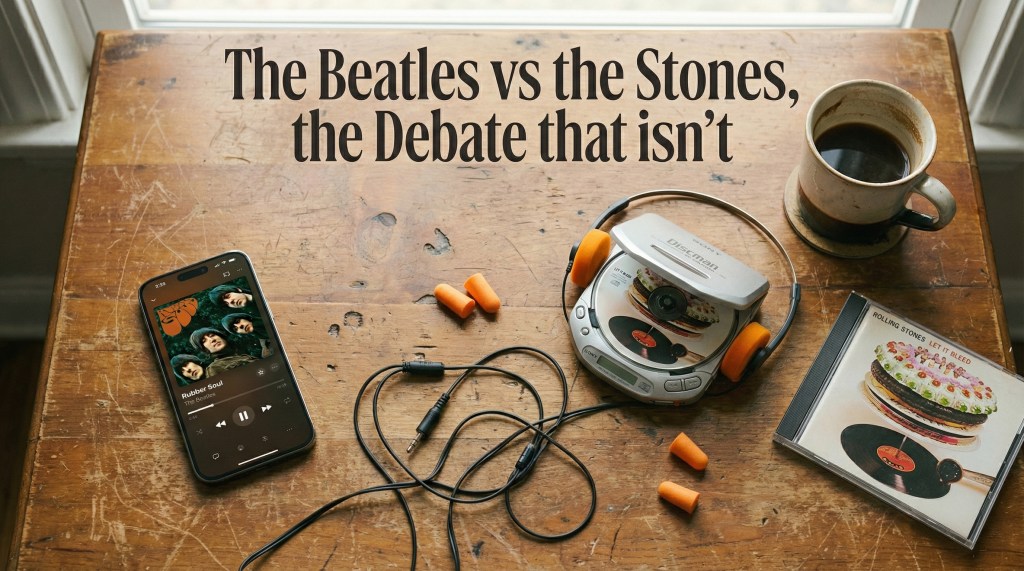
By Jan Vranken
Let me be brutally clear from the start: this isn’t a debate. It never was. The Beatles versus The Rolling Stones is music journalism’s most persistent fairy tale, a manufactured rivalry designed to sell magazines and fill column inches during slow news weeks. The truth? It’s not even close. It’s never been close. And anyone with functioning ears and basic musical literacy knows it.
I’ve spent forty years writing about music. I’ve covered everyone from Orchestra Baobab to Johnny Marr, from Senegalese mbalax to British progressive rock. I’ve interviewed legends, dissected masterpieces, and sat through enough mediocre concerts to recognize brilliance when I hear it. And here’s what four decades of critical listening has taught me: The Beatles are untouchable. The Rolling Stones aren’t even in the top thirty bands of all time.
That’s not hyperbole. That’s not clickbait. That’s documented, verifiable, objective truth, and I’m about to prove it.
BY THE NUMBERS: THE MASSACRE
Let’s start where all honest discussions should begin, with facts that can’t be argued, spun, or reinterpreted by nostalgic Stones apologists.
The Beatles have sold over 600 million albums worldwide. The Rolling Stones have sold approximately 200 to 250 million. The Beatles sold roughly 2.5 times more records in one-sixth of the time. They achieved this in ten years, from 1960 to 1970. The Stones have been touring since Jesus walked the earth and still can’t catch up.
In terms of chart domination, The Beatles had 20 number one hits in the United States. The Stones managed eight. The Beatles had 17 UK number one hits, spending 69 weeks at the top. The Stones had eight UK number ones, spending 18 weeks at number one. The Beatles scored 19 number one albums on the Billboard 200 from just 12 studio albums plus compilations. The Stones had fewer number one albums despite releasing over 30 studio albums.
Let that sink in. The Beatles had a conversion rate of nearly 75 percent. Nearly every album they touched turned to gold. The Stones needed three times as many attempts to achieve less.
When it comes to awards and recognition, The Beatles won seven competitive Grammy Awards from 27 nominations, plus a Grammy Lifetime Achievement Award. They collected 17 NME Awards, 15 Ivor Novello Awards, four Brit Awards, one Academy Award, and four MBEs in 1965. The Rolling Stones won three Grammy Awards, one Grammy Lifetime Achievement Award, and nine NME Awards. Mick Jagger received one controversial MBE, which Queen Elizabeth II reportedly scheduled during her knee surgery so she wouldn’t have to present it herself.
These aren’t opinions. These are facts. And facts don’t care about your feelings or your teenage rebellion fantasies about Mick Jagger being dangerous.
THE INNOVATION CHASM: CREATORS VS. COPIERS
Here’s where the real gap becomes a fucking canyon.
The Beatles didn’t just make music, they invented modern recording. They transformed the studio from a documentation room into a creative laboratory. They wrote the manual that every band since has followed.
Under George Martin’s guidance, often called the true Fifth Beatle, The Beatles pioneered techniques that are now standard across the industry. They were the first to use feedback intentionally as a musical element on “I Feel Fine.” They experimented with reversed recordings on “Rain” and “Tomorrow Never Knows,” introducing tape loops and musique concrète into pop music. They developed varispeed recording techniques, Automatic Double Tracking, and Leslie speaker effects on vocals and instruments. They pushed multitrack recording forward, starting with four-track on “I Want to Hold Your Hand.” They used close-miking of strings on “Eleanor Rigby,” creating intimacy in orchestral arrangements.
Each of these techniques is now standard. Every producer, every engineer, every bedroom musician uses tools The Beatles invented or perfected. They didn’t just make albums, they redefined what an album could be.
Musically, The Beatles were the first pop group to feature a string quartet on “Yesterday.” They employed a 40-piece orchestra on “A Day in the Life.” They integrated Indian classical music into Western pop with “Within You Without You” and “Norwegian Wood.” They used unconventional time signatures, like the 7/4 sections in “All You Need Is Love.” They created the concept album itself with Sgt. Pepper’s as a unified artistic statement. They treated albums as art objects rather than mere collections of singles, starting with Rubber Soul.
And what did The Rolling Stones contribute to recording innovation? Fucking nothing.
They made “Their Satanic Majesties Request” in 1967, a clumsy, embarrassing attempt at psychedelia that came out after Sgt. Pepper’s had already redefined the genre. Critics called it clumsily executed. The Stones themselves refuse to play most of it live. It’s the album they pretend doesn’t exist.
That’s the pattern: The Beatles led, The Stones followed. The Beatles covered Chuck Berry in 1963. The Stones covered Chuck Berry in 1964. The Beatles perfected the art of the single in 1963 and 1964. The Stones did it several months later. The Beatles created psychedelic masterpieces. The Stones made a bad copy. The Beatles were innovators. The Stones were practitioners.
THE SONGWRITING ABYSS: GENIUS VS. COMPETENCE
This is the heart of the matter. This is where the debate, if there ever was one, dies completely.
John Lennon and Paul McCartney wrote approximately 180 songs together. Their partnership is universally acknowledged as the most successful songwriting collaboration in history. “Yesterday” is the most covered song of all time according to Guinness World Records, with over 3,000 recorded versions. Beatles songs have been covered 600-plus times by other artists across every imaginable genre, from rock and pop to classical, jazz, blues, and country.
But it’s not just quantity, it’s the range, the depth, the evolution. From “Love Me Do” in 1962 to “A Day in the Life” in 1967 is five years. In those five years, Lennon-McCartney evolved from simple three-chord love songs to symphonic rock operas. Show me another songwriting team that made that leap.
Their compositional genius spanned harmonic sophistication with modal interchange, secondary dominants, and complex chord progressions. McCartney’s melodies on “Yesterday,” “Let It Be,” and “Hey Jude” are timeless. Their lyrical depth progressed from “I Want to Hold Your Hand” to “Strawberry Fields Forever,” from teenage romance to psychedelic philosophy. They experimented with structural innovation, like “Happiness is a Warm Gun,” which contains four distinct sections, none of them conventional.
George Martin said the key to their success was their friendly rivalry. Each pushed the other to be better. When Lennon brought in “Strawberry Fields Forever,” McCartney answered with “Penny Lane.” When McCartney wrote “Eleanor Rigby,” Lennon countered with “Tomorrow Never Knows.” That competitive creative synergy produced the greatest catalog in popular music.
Jagger-Richards are competent rock and roll songwriters. Let me be clear: they wrote some great songs. “Satisfaction,” “Gimme Shelter,” “Brown Sugar,” these are classics. But here’s the problem: they’re all the same song.
Keith Richards has literally built his entire career on three chord progressions in open G tuning. And he didn’t even invent that tuning. Ry Cooder showed it to him during the “Performance” soundtrack sessions in 1969.
Listen to “Brown Sugar” from 1971. Now listen to “Start Me Up” from 1981. It’s the same fucking riff. Ten years apart, same song, different words.
Jagger-Richards never evolved. They found a formula in 1965 and have been recycling it for sixty years. There’s no growth, no experimentation, no artistic risk.
Compare the range. The Beatles gave us “Yesterday” to “Helter Skelter” to “Across the Universe” to “Come Together,” all completely different, all masterpieces. The Stones gave us “Satisfaction” to “Jumpin’ Jack Flash” to “Brown Sugar” to “Start Me Up,” all variations on the same blues-rock riff.
Keith Richards himself admitted it. About “Exile on Main St.,” he said he was no longer interested in hitting number one in the charts every time. Translation: we gave up trying to innovate.
And Mick Jagger, in 1972, explicitly stated that he was bored with rock and roll. So they kept making the same album for forty more years. Not because of artistic vision, because of artistic bankruptcy.
THE LONGEVITY LIE: ARTISTIC INTEGRITY VS. FINANCIAL DESPERATION
The most common defense of The Stones: they’ve lasted sixty years, Beatles only lasted ten.
This is the weakest argument in the entire debate, and I’m going to bury it.
The Beatles stopped because they had nothing left to say as a band. They’d revolutionized pop music in a decade, from “Love Me Do” to “Abbey Road.” Every album was a leap forward. Rubber Soul sounded nothing like Help!. Revolver was a complete departure from Rubber Soul. Sgt. Pepper’s broke all remaining rules.
They lived on innovation and synergy. When that creative electricity began to fade, when Lennon and McCartney went from complementary to conflicting, they had the artistic integrity to stop. They refused to repeat themselves. This wasn’t creative exhaustion, it was artistic evolution. They wanted to grow as individuals beyond what the band structure allowed.
George Martin himself said the Beatles hadn’t reached their musical peak when they split. He cited Abbey Road as proof of how strong they still were musically when they could work together harmoniously.
The Stones, meanwhile, have been doing the same act since the crucifixion of Christ. Every album since 1972 features guitar riffs in open G tuning, Jagger’s preening, the eternal blues-rock formula. Sixty years of the same pose, the same sound, the same tired rebellion that stopped being rebellious around 1975. That’s not longevity, that’s artistic stagnation.
Quality over quantity. The Beatles made 12 studio albums, all relevant, all influential, all part of music history. The Stones made over 30 studio albums, of which maybe five actually matter: “Beggars Banquet,” “Let It Bleed,” “Sticky Fingers,” “Exile on Main St.,” and “Some Girls.” The rest? Filler for nostalgic stadium tours.
And let’s be honest about why The Stones stayed together. They had tax problems and fled Britain in 1971 to avoid seizure of assets. None of them were relevant solo. Jagger’s solo career? Flop after flop. “She’s The Boss”? Nobody remembers it. Keith Richards’ “Talk Is Cheap”? Pleasant, but irrelevant. Without each other, they’re nothing.
Compare that to Beatles solo careers. McCartney created Wings, “Band on the Run,” “Live and Let Die,” and built a billion-dollar solo career. Lennon gave us “Imagine” and “Plastic Ono Band,” cultural icons both. Harrison produced “All Things Must Pass,” a triple album better than anything The Stones ever made. Even Ringo had hits.
The Beatles were four talents who elevated each other. The Stones are one act divided over five bodies. The Stones didn’t stay together out of artistic commitment. They stayed together out of financial necessity and ego preservation. That’s not dedication, that’s desperation.
THE LIVE PERFORMANCE MYTH: CIRCUS ACT VS. MUSICIANS
“The Rolling Stones, The World’s Greatest Rock ‘n’ Roll Band!”
It’s their tagline. It’s printed on tour posters. It’s repeated by journalists who should know better. It’s complete bullshit.
Let me speak as a working musician who’s analyzed performances for forty years. The only real musician in The Rolling Stones was Charlie Watts. And Charlie is dead.
What remains? A guitarist who knows three chord progressions, a singer who can’t actually sing, and a collection of hired guns keeping the show running.
Keith Richards can barely play guitar. His entire repertoire consists of recycled riffs in open G tuning, a tuning he didn’t even invent. Ry Cooder showed it to him. Richards’ greatest talent is recycling the same riff for six decades. Musical innovation? Forget it. George Harrison’s guitar work on “While My Guitar Gently Weeps,” “Something,” or his sitar experiments, that’s musical craftsmanship. Richards is a one-trick pony who gets credit for longevity rather than skill.
Mick Jagger’s vocals? Not exactly what you’d call trained. Jagger has charisma, stage presence, but vocally? McCartney could switch from “Yesterday” to “Helter Skelter.” Lennon from “Imagine” to “Twist and Shout.” Harrison’s harmony work, Ringo’s perfect timing, that’s musical proficiency. Jagger? He squawks. Same affected rasp for sixty years. His vocal technique is non-existent. He survives on attitude, not ability.
And here’s the dirty secret of Stones live shows: they’re best with other people on stage. Look at their classic performances, always supplemented with session musicians, horn sections, backing vocalists. The Stones can’t even perform their own songs without help.
Mick Taylor from 1969 to 1974 was their best guitarist ever, and he was a John Mayall’s Bluesbreakers veteran they hired. Ron Wood is a sideman who never contributed original Stones material.
Live band? The Beatles performed 1,400 concerts in four years: Hamburg, Cavern Club, world tours. They stopped touring because 1966 technology couldn’t reproduce their studio innovations. Their music had become too complex for live performance with available equipment.
Listen to Beatles bootlegs. Even with screaming teenage girls drowning everything out, you hear tight, professional performances. Ringo holds it together, McCartney’s bass is impeccable, the harmonies are perfect.
Stones concerts? Sloppy, loose, often out of tune. It gets sold as rock and roll looseness, but it’s just lack of discipline. Charlie held things together, but the rest? Jagger poses, Richards stands spread-legged pretending he invented the guitar, and the music is mostly volume and attitude.
As a musician listening critically, Stones live performances are incoherent, with everyone doing their own thing. They’re dynamically flat, everything at the same volume with no subtilety. They’re vocally weak, Jagger can’t even approach his studio work live. They’re predictable, you know exactly what’s coming after the first eight bars.
Beatles live, even in 1966 with primitive PA systems, were tight ensembles with four musicians thinking as one. They were vocally perfect with harmonies locking even under stress. They were musically adventurous, taking risks and trying new things.
The Stones aren’t a live band, they’re a circus act. Spectacle instead of substance.
Now that Charlie’s dead, there’s no musician left in the band. What remains? A guitarist who knows three chords, a singer who can’t sing, and a tribute band to themselves.
THE CULTURAL IMPACT: MOVEMENT VS. SOUNDTRACK
The Beatles didn’t just make music, they changed the world.
Beatlemania wasn’t just a marketing term, it was a sociological phenomenon. 73 million Americans, nearly half the population, watched The Ed Sullivan Show on February 9, 1964. The Beatles helped America recover from national depression after JFK’s assassination. They spearheaded the British Invasion, shifting global power from American to British acts. In 1965, they became the first rock band awarded MBEs, recognition from the very establishment they were supposedly rebelling against.
The Beatles weren’t just pop stars, they were cultural revolutionaries. They spoke out against racial segregation, refusing to play a Jacksonville concert in 1964 unless the audience was integrated. Officials complied. They became leaders of the counterculture and hippie movement. “All You Need Is Love” became the anthem of the Summer of Love in 1967.
Music historian Greil Marcus called The Beatles the second pop explosion after Elvis, cutting across lines of class and race and dividing society by age. A Rolling Stone critic once observed: Remove the Stones’ music from the sixties and you have a rock and roll hole. Remove The Beatles’ music from the sixties and you have a cultural hole.
The Stones had a bad boy image, but it was mostly marketing courtesy of manager Andrew Loog Oldham. Their biggest cultural contribution? Altamont in 1969. Their free concert ended in violence and murder when Meredith Hunter was stabbed to death by Hell’s Angels hired as security. It symbolized the dark end of the sixties.
The Beatles represented hope, change, evolution. The Stones represented hedonism and danger, but by 1970, even that felt manufactured and tired.
THE AUTHENTICITY CON: RESPECT VS. EXPLOITATION
People claim the Stones are more authentic because they’re closer to the blues. Horseshit.
The Beatles respected their influences: Little Richard, Chuck Berry, Carl Perkins. They covered them, credited them, brought them on tour.
The Stones exploited black American music. They took blues and R&B, wrapped it in white packaging, and sold it to white kids as dangerous. That’s not authenticity, that’s cultural appropriation as marketing strategy.
Muddy Waters, Howlin’ Wolf, John Lee Hooker, that’s blues. Real, raw, authentic. The Stones play a watered-down, whitewashed version for stadium audiences who think they’re edgy for listening to it.
And the Stones never properly acknowledged their debt. They got rich off black music while the original artists died poor. That’s the Stones’ legacy.
THE VERDICT: NOT EVEN IN THE TOP 30
Here’s my claim: The Rolling Stones aren’t in the top 30 bands of all time.
Controversial? Sure. But I can prove it.
Bands objectively more important or better than The Rolling Stones include The Beatles, obviously. Led Zeppelin for technical perfection and inventing heavy metal. Pink Floyd for conceptual masterworks and sonic innovation. The Who for rock opera, feedback, and power chords. Queen for compositional range and Freddie Mercury’s genius. Bob Dylan for songwriter genius and cultural impact. Jimi Hendrix Experience for guitar revolution. The Doors for poetry and psychedelia. Nirvana for the grunge revolution and generational voice. Radiohead for modern rock evolution with “OK Computer.”
David Bowie, the chameleon who constantly reinvented himself. The Velvet Underground for underground influence and art-rock. Black Sabbath for creating heavy metal. Ramones for pioneering punk and changing everything. Sex Pistols for cultural explosion and societal impact. The Clash for punk evolution and political consciousness. R.E.M. for alternative rock foundation. U2 for stadium rock redefined and sustained excellence.
Talking Heads for new wave innovation. Kraftwerk for electronic music pioneering and influencing everyone. Public Enemy for revolutionary hip-hop and political power. The Smiths for Morrissey and Marr genius. Joy Division for post-punk and Ian Curtis’ tragic brilliance. The Cure for goth rock and emotional depth. Sonic Youth for noise rock and indie influence. My Bloody Valentine for creating shoegaze with “Loveless.” Pixies for loud-quiet dynamics that influenced Nirvana. The Stooges for proto-punk and Iggy’s insanity.
And I could keep going. Patti Smith. Television. Wire. Gang of Four. The Replacements.
The argument: The Stones are a mediocre band that got lucky with timing and marketing. As a working musician listening critically, they’re repetitive with every album sounding the same. They’re technically limited, Richards’ guitar work is primitive and Jagger can’t really sing. They’re rhythmically boring, even with Charlie it was predictable. They’re harmonically stupid, three chords and lack of imagination.
They’re a competent cover band that lucked into writing originals. They’ve never been musically interesting. They have one trick and they’ve been doing it for sixty years. That’s not excellence, that’s musical poverty.
FINAL WORD: IT’S NOT BEATLES VS. STONES
Here’s the truth that makes Stones fans uncomfortable: It’s not Beatles vs. Stones. It’s Beatles vs. Everyone Else.
The Beatles stand alone. They’re not competing with The Rolling Stones any more than Shakespeare competes with whoever wrote “Fifty Shades of Grey.”
The Beatles invented modern recording, revolutionized songwriting, changed culture globally, influenced every artist since, sold more records than anyone, won more awards than any band, and did it all in ten years.
The Rolling Stones played blues-rock, toured a lot, made some good albums in the early seventies, and have survived on nostalgia since 1981.
That’s the debate. That’s the rivalry. There is no debate. There never was.
The Beatles are the greatest band of all time. The Rolling Stones are a good band that stuck around too long.
And anyone who argues otherwise either wasn’t paying attention, has defective hearing, or is lying to themselves about what music they liked when they were seventeen.
Jan Vranken has been writing about music for forty years, covering everything from West African mbalax to British progressive rock. He’s heard enough to know greatness when it exists, and mediocrity when it’s overhyped. This is his definitive statement on rock’s most overrated rivalry.
This piece appears in Maxazine and on Writerz Block.
 Writerz Block
Plaats een reactie