
By Jan Vranken | Writerz Block
I have a Facebook friend named Charley, and he is not a bad person. He is curious, engaged, and genuinely troubled by what is happening in the world. He reads. He thinks. He cares about the things he shares.
He is also, increasingly, a one-man distribution node for some of the most sophisticated propaganda currently in circulation.
This is not a takedown. It is a case study. Because Charley is not unusual. Charley is everywhere.
Exhibit A: The Flyer
On March 2nd, Charley shared a post from a page called The Green News Network. It was a photograph of someone holding a printed flyer, the kind you’d see at a protest. Two columns. Iran on the left, Israel on the right. A neat comparison designed to answer its own question: Who’s the real threat?
The flyer made several specific claims. Iran, it said, had never attacked a neighbor. Iran had signed the NPT. Iran allowed IAEA inspections. Israel, by contrast, had attacked its neighbors repeatedly, refused to sign the NPT, allowed no inspections, and possessed 400 nuclear weapons.
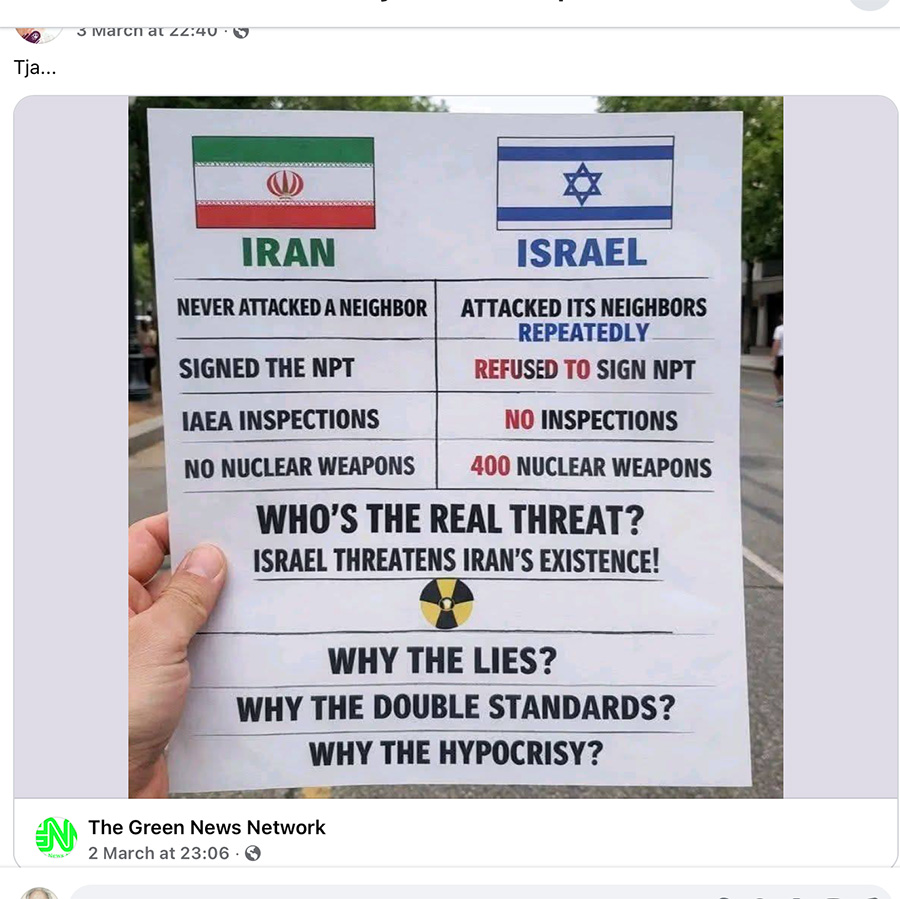
Charley’s caption was a single word: Tja…
That ellipsis is doing a lot of work. It says: I’m not claiming this is true. I’m just… thinking out loud. Sharing something interesting. Tja.
The flyer is, in fact, a collection of half-truths, omissions and fabrications dressed up as a balanced comparison. Iran has not launched a direct conventional invasion of a neighbor — that much is technically accurate — but it has spent decades conducting proxy warfare through Hezbollah in Lebanon, the Houthis in Yemen, and Shia militias across Iraq and Syria. In April 2024, Iran fired hundreds of drones and ballistic missiles directly at Israeli territory. That is an attack on a neighbor by any reasonable definition.
The IAEA inspections claim is similarly misleading. Iran has repeatedly blocked inspectors from accessing suspected sites, while enriching uranium to between 60 and 84 percent — just shy of weapons-grade. And the 400 nuclear weapons figure for Israel? Independent institutes including SIPRI consistently estimate the actual number at somewhere between 80 and 100. The figure 400 has no credible sourcing. It is a propaganda number, inflated to make Israel seem uniquely monstrous.
Two points on the flyer are actually correct: Israel has not signed the NPT and does not allow inspections at Dimona. Those are legitimate criticisms. But embedding two accurate facts inside a structure of distortion is precisely what makes this kind of content effective. It feels balanced. It feels researched. It feels like someone did their homework.
The Defense
When criticism arrived in the comments, Charley responded. His reply is worth quoting in full, because it is a near-perfect specimen of a particular kind of social media reasoning:
“Look guys, I post what I find interesting — I don’t have to agree with it a hundred percent. But don’t conveniently forget who started this war, and on what pretexts. Check out Jeffrey Sachs or John Mearsheimer once in a while. Try reading something other than the MSM.”
Unpack this carefully, because there are three distinct moves happening simultaneously.
The first is the disclaimer of personal responsibility. I don’t have to agree with everything I post. This is the just asking questions defense, the rhetorical escape hatch that allows you to distribute content without owning it. If the flyer turns out to be accurate, Charley shared the truth. If it turns out to be propaganda, Charley merely found it interesting. The share carries no risk, only potential reward.
The second move is the invocation of serious names. Jeffrey Sachs is a prominent economist and development scholar at Columbia University. John Mearsheimer is one of the most cited political scientists of the past thirty years, a genuine heavyweight in international relations theory whose work on great power competition and the origins of the Ukraine war has attracted both admiration and fierce controversy. These are real thinkers with real arguments worth engaging.
But notice what Charley is doing with them. He is not saying: here is Mearsheimer’s specific argument about the origins of the Iran-Israel conflict, and here is how this flyer relates to it. He is using the names as a retroactive credential — a way of suggesting that the flyer, and his sharing of it, belongs to the same intellectual tradition as serious academic dissent from mainstream narratives. Sachs and Mearsheimer become a shield. The flyer borrows their authority without earning it.
The third move is the most familiar: ” Try reading something other than the MSM.” Read something other than the mainstream media. This is the master key that opens every door. Once you’ve established that mainstream sources are inherently compromised, anything outside them gains automatic credibility. The Green News Network, thecurrent.pk, Press TV — none of these need to demonstrate journalistic standards, because they are, by definition, not the MSM. Their outsider status is their credential.
Exhibit B: One Week Later
Five days after the flyer, on March 7th, Charley shared another post. This one came from thecurrent.pk, a Pakistani outlet with no visible editorial board and a clear geopolitical perspective. The headline: “Indian journalist reveals Israel hides casualties, forbids taking photos of bodies.”
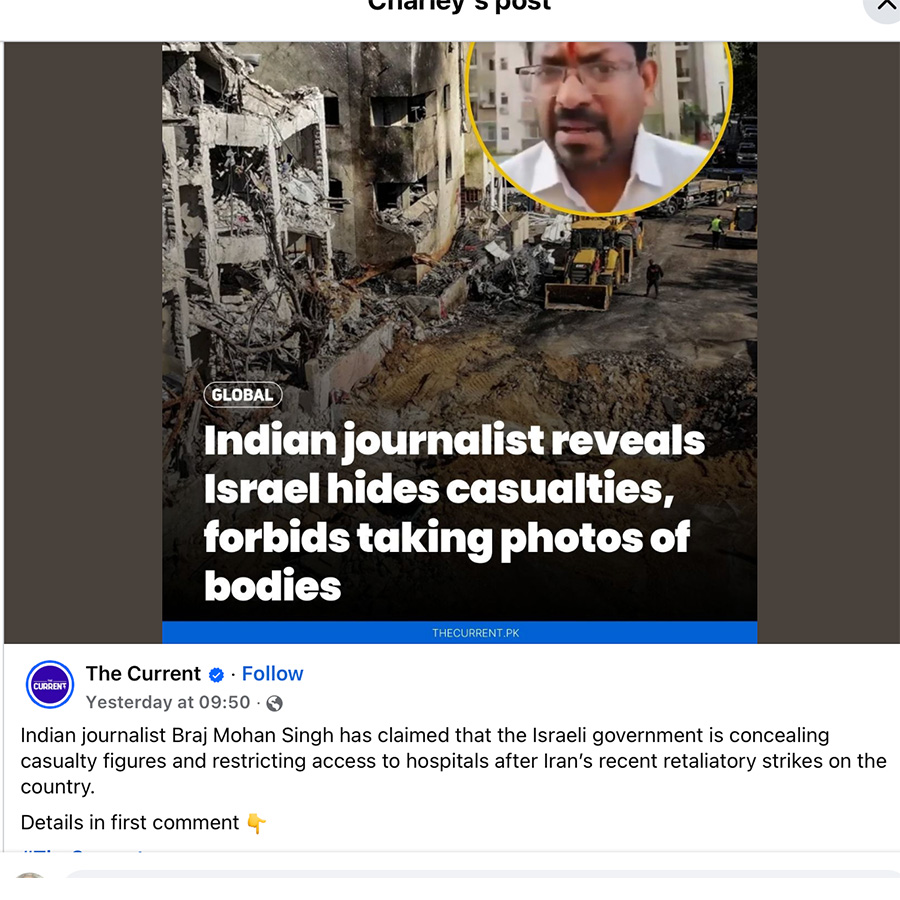
This story has a real journalist at its center. Braj Mohan Singh of India’s Sadhna News was trapped in Israel from February 28th to March 6th, having traveled there to cover Prime Minister Modi’s state visit. When he returned home, he spoke publicly about access restrictions he had experienced: journalists barred from filming casualties, denied access to hospitals, given casualty figures that didn’t match what local witnesses were saying.
His account is credible. Wartime military censorship is a documented, universal reality. Every war correspondent who has ever been managed by a military press officer will recognize Singh’s frustrations.
But now trace the journey from Singh’s interview to Charley’s feed. The story was first amplified by Press TV — Iran’s state-owned international broadcaster, funded by the Islamic Republic, banned in the United Kingdom for breaching impartiality standards, operating on a budget that Tehran recently tripled to $480 million. Press TV did not frame this as “journalist describes wartime censorship.” It framed it as “Indian journalist reveals severe Israeli censorship after escape from occupied territories.” From Press TV, it migrated to Pakistani social media ecosystems and eventually to thecurrent.pk, which ran it under a headline that converted Singh’s personal frustrations into institutional fact.
By the time it reached Charley, it had the visual grammar of journalism — a logo, a dateline, a named source. What it had lost along the way was context, nuance, and any acknowledgment of who was doing the amplifying and why.
What Iran Is Actually Doing
Here it is worth pausing on Iran’s broader information operation, because it makes the mechanics visible in a way that the more subtle cases do not.
Since the US-Israeli strikes of February 28th, Iran’s state media apparatus has been operating at full capacity. The monitoring organization NewsGuard documented 18 false war-related claims by Iranian sources in the first week of the conflict alone. The cases are not subtle.
Iran’s state broadcaster IRIB TV1 aired dramatic missile footage on the first day of the conflict that turned out to be archival material, not footage from the current war. In one particularly brazen instance, the same channel used muted footage of an Israeli attack on Iran as b-roll while narrating a story about Iranian strikes on Israel. Press TV published a photograph of a Pakistani drone labeled as “Israeli drone shot down near the Natanz nuclear site.” Ukrainian war footage was recycled and captioned as damage in Tel Aviv. When the IRGC claimed its missiles had struck the USS Abraham Lincoln, US Central Command responded directly: “Iran’s IRGC claims to have struck USS Abraham Lincoln with ballistic missiles. LIE. The Lincoln was not hit.” PolitiFact subsequently found that one of the videos Iran circulated to support the claim had been online since at least 2021.
This is one end of the spectrum: crude, fast, and easily debunked. A carrier that wasn’t hit. A drone with a different flag. A video from another war. These fabrications can be knocked down within hours.
The Singh story operates at the other end: a real journalist, real frustrations, real access restrictions — filtered through state media, repackaged with a loaded headline, distributed through a chain of increasingly anonymous outlets. This kind does not get debunked. It lives in the feed. It becomes part of what people know.
And the flyer sits somewhere in the middle: two facts, several distortions, professional graphic design, shared by a page called The Green News Network with the kind of reach that algorithms reward.
The Charley Problem
I want to be careful here, because it would be easy to be condescending, and condescension is both unwarranted and counterproductive.
Charley is right that Jeffrey Sachs and John Mearsheimer are worth reading. He is right that mainstream media have blind spots, proximity to power, and documented failures of coverage. He is right that the origins and conduct of the Iran-Israel-US conflict deserve scrutiny that goes beyond official narratives. The frustration that drives people toward alternative sources is not irrational. The suspicion that something is being left out is, often, correct.
But there is a difference between the mainstream media don’t tell the whole story and therefore anything outside the mainstream is filling the gap. The second does not follow from the first. Press TV is not outside the mainstream because it is braver. It is outside the mainstream because it serves a state that has a $480 million annual budget for international propaganda and a direct material interest in how you perceive this conflict.
The Green News Network is not an alternative to The New York Times. It is a Facebook page.
thecurrent.pk is not Jeffrey Sachs.
And Tja… is not a disclaimer that absolves you of responsibility for what you put in front of your friends.
The Question I Keep Coming Back To
Here is what genuinely puzzles me as a journalist, and what I think deserves to be said plainly.
Scrolling through Charley’s feed takes effort. Finding these posts, evaluating them as interesting, sharing them with commentary — that is an active, recurring investment of time and attention. The flyer from The Green News Network. The piece from thecurrent.pk. The next one, and the one after that. Charley is not passively absorbing content. He is curating it.
And yet: a well-reported piece in The New York Times, The Guardian, or De Correspondent on the exact same conflict — the Iran-Israel war, press freedom, casualty reporting, the geopolitics of the region — would take less time to read than it takes to find and share a Pakistani aggregator post. It would be written by journalists with named bylines, editorial oversight, and professional accountability. It would contain the kind of sourcing and context that the flyer and the thecurrent.pk post conspicuously lack. And it would still, in many cases, contain legitimate criticism of Israeli policy, American foreign policy, the failures of Western media. Good journalism is not the same as official narrative.
So why doesn’t Charley read that instead?
I think the honest answer is that the NYT piece doesn’t give Charley what the flyer gives him. A well-reported newspaper article says: here is complex information, carefully gathered, with important caveats. The flyer says: you have seen through the lies. You know what they don’t want you to know. One is information. The other is identity.
Sharing a flyer that exposes Israeli hypocrisy, or a story that reveals what the MSM is hiding, positions Charley not as a news consumer but as a truth-teller — someone who has done the work, cracked the code, and is now generously bringing the hidden reality to his friends’ attention. The name-dropping of Mearsheimer and Sachs serves the same function: you don’t actually have to read The Tragedy of Great Power Politics to invoke Mearsheimer. The name alone signals membership in a community of serious, independent thinkers.
Meanwhile, sharing a New York Times article signals nothing except that you read the New York Times. In the epistemic world Charley now inhabits, that is practically a confession.
This is what makes the system so effective and so hard to argue against. The problem is not that Charley lacks access to good journalism. The problem is that good journalism is no longer giving him what he needs from information — which is not, primarily, to be informed. It is to feel like someone who sees clearly in a world of deliberate blindness.
The people who built the flyer and run thecurrent.pk understand this perfectly. They are not in the news business. They are in the identity business. And business, clearly, is good.
A Practical Question
The standard advice is: check your sources. But that advice assumes the problem is insufficient verification, when the real problem is often something more structural — a media environment specifically designed to route around skepticism by exploiting legitimate distrust.
So before you share something, try asking not just is this true? but who benefits from me believing this, and why are they the ones pushing it?
A flyer comparing Iran and Israel, circulated at protests and shared by pages with names like The Green News Network, benefits someone. A story about Israeli casualty concealment, amplified by Iranian state media and distributed through Pakistani outlets with no editorial standards, benefits someone. That does not automatically make the underlying content false. But it does mean the framing, the selection, and the emotional payload have been shaped by interests that are not yours.
Charley wants people to read more, think more, question the mainstream. These are good instincts. The tragedy is that the machine that built the flyer and runs thecurrent.pk is counting on exactly those instincts to get its content into your feed.
Charley is a good person navigating a system designed to exploit good people.
The least we can do is name the system.
Jan Vranken is a music journalist and cultural critic with forty years of experience, writing for Maxazine and his own blog Writerz Block. He covers music, media, politics, and the occasional Facebook friend.
 Writerz Block
Plaats een reactie