Jóhann Jóhannsson: Piano Works
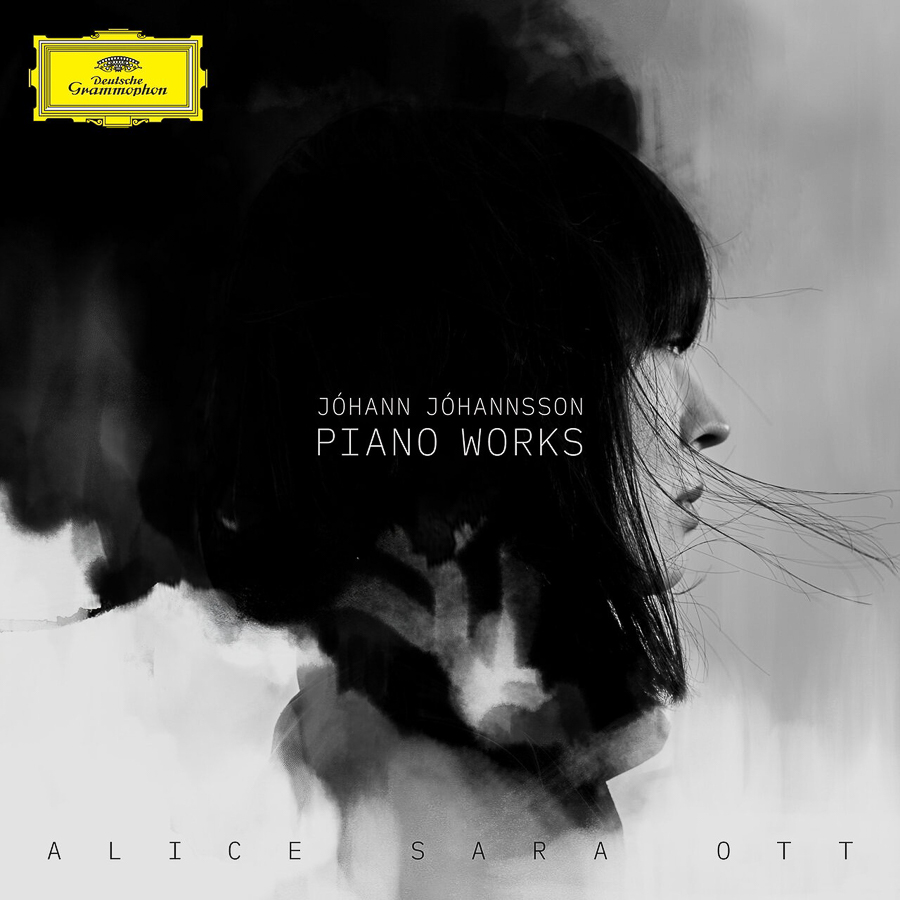
written by Jan Vranken
Imagine a dimly lit studio in Reykjavik, an upright piano, and a pianist holding a conversation with someone who is no longer there. That is the essence of ‘Jóhann Jóhannsson: Piano Works’, the most intimate and unexpected album Alice Sara Ott has released to date. Out on 6 March 2026 via Deutsche Grammophon, it is a tribute to Icelandic composer Jóhann Jóhannsson, who passed away in February 2018 at the age of 48, at the height of his creative powers.
The German-Japanese pianist, who began her career as a child prodigy and has since become one of the most-streamed classical pianists in the world, never met Jóhannsson in person. That fact makes this project simultaneously so unlikely and so remarkable. Rather than knowing the man, she came to know his music from the inside, through conversations with his friends and collaborators, and through the thirty transcriptions published by Faber Music for this project.
The choice of instrument
The story really begins with a piano. Not the gleaming concert grand you would normally expect from Ott, but an old, slightly worn upright belonging to producer and sound engineer Bergur Þórisson, a former collaborator of Jóhannsson himself. The sound of that piano, more muted and somewhat more fragile than her usual instrument, immediately sets the character of the album: nostalgia as tone colour, memory as an acoustic phenomenon. Ott described the recording sessions as feeling as though she were inside a cloud, which is precisely the right description of what the listener experiences.
Jóhannsson wrote his music for orchestras, choirs, synthesizers and electronic layers. He was a composer who deliberately ignored the boundaries between classical, minimalism, ambient and film music. The question this album poses is therefore anything but trivial: what remains when you strip away all those layers and leave only the piano?
What remains
The answer is surprisingly much. ‘The Sun’s Gone Dim and the Sky’s Turned Black’, the album’s longest track at nearly five minutes, is the clearest proof. The piece, originally based on a poem by John Grant, sounds in Ott’s version as if the world is pausing to catch its breath. Her touch is restrained but never cold, and it is precisely in the silences between the notes that the architecture of Jóhannsson’s writing reveals itself. Anyone unfamiliar with Jóhannsson but who has seen films such as ‘Arrival’ or ‘The Theory of Everything’ will immediately recognise the unease and melancholy that make his film music so unmistakable. The latter piece also features on this album and serves as an excellent entry point for new listeners.
The segments drawn from ‘Englabörn’, Jóhannsson’s debut album from 2002, form a strong centrepiece. The title track ‘Englabörn’ itself, as well as ‘Jói & Karen’ and ‘Bað’, demonstrate how his early, spare compositions already contained everything that would later make him great. ‘Flight from the City’, also nearly five minutes long, is the closest this album comes to an emotional climax, and Ott plays it with a composure that only makes it more affecting.
Minor reservations
Thirty tracks in just over three quarters of an hour means that many pieces fall short of two minutes. That is a deliberate choice, suited to the fragmentary nature of much film music, but it also means that the album can slip by unnoticed when listened to without full attention. ‘Ruslpóstur’ all but disappears before it has begun. That is not a failing of Ott, but of the format: a selection of thirty miniatures demands a different mode of listening than a traditional recital programme, and that asks something of the listener in return.
Moreover, this album is explicitly an interpretation, not a composition. Ott plays with virtuosity but without ego, and that is precisely her strength here. Those in search of the full, sweeping production of the original ‘Orphée’ or the cinematic tension of ‘Sicario’ will find something missing. But that is not what this album sets out to be.
Conclusion
‘Jóhann Jóhannsson: Piano Works’ is an album about presence in absence. Alice Sara Ott has not built a posthumous monument, but something more personal: a conversation she initiated herself, on a worn instrument, in a dark studio in the city where Jóhannsson grew up. The result is understated, honest and quietly beautiful. Whether Jóhannsson would have agreed? Nobody knows. But it sounds as though he was there.
(8.5/10) (Deutsche Grammophon)
 Writerz Block
Plaats een reactie