By;Jan Vranken
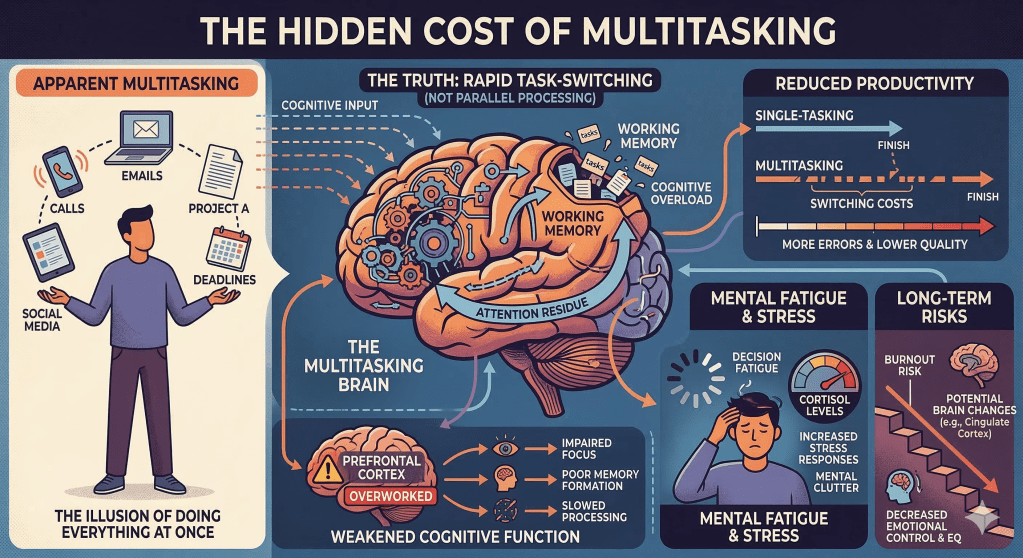
We live in a world that celebrates busyness. Answering emails while on a call, scrolling your phone during a meeting, switching between ten browser tabs — it feels productive. It isn’t.
Neuroscience is pretty clear on this: the human brain cannot truly multitask. What it does instead is rapidly switch between tasks — and every switch comes at a cost. Researchers call it “switching cost.” Each time your brain jumps from one task to another, it takes time to reorient, refocus, and reload the context of what you were doing. Studies from the American Psychological Association found that switching tasks can cost as much as 40% of productive time over the course of a day.
It gets worse. Every interruption — a notification, a quick question, a tab switch — doesn’t just pause your work. It derails a cognitive state called “flow,” the deep focus state where your best thinking actually happens. Getting back into flow after an interruption takes an average of 23 minutes, according to research from UC Irvine.
The people who appear to multitask well aren’t actually better at doing two things at once. They’re often just better at tolerating chaos — which is a different skill entirely, and not always a useful one.
The solution is almost embarrassingly simple: do one thing at a time. Close the tabs. Silence the phone. Block the time. Your output quality will improve, your stress will drop, and you’ll finish faster than you would have otherwise.
Singletasking is the new superpower nobody’s talking about.
 Writerz Block
Plaats een reactie