written by : Jan Vranken
Your home might be making you tired — even when you’re doing nothing in it.
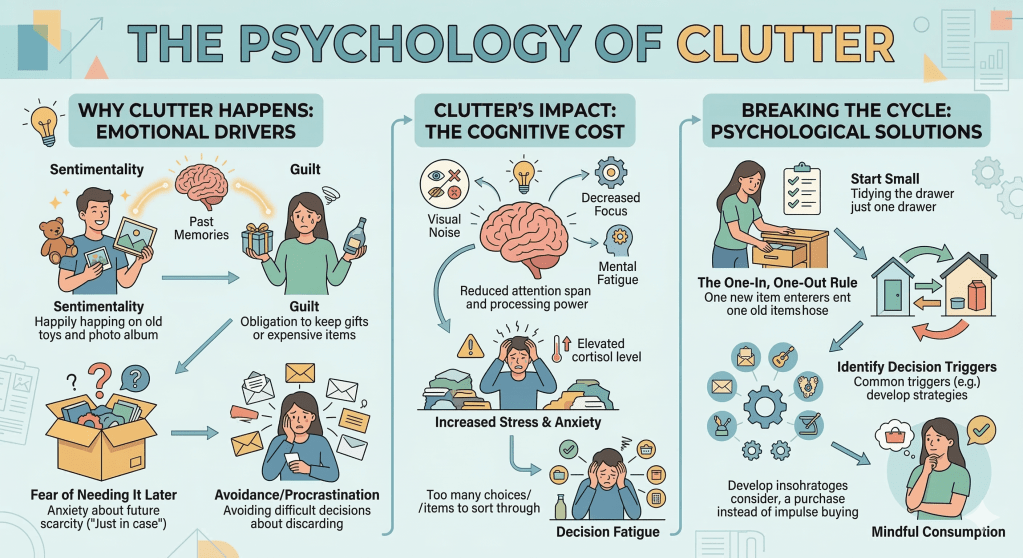
Research in psychology consistently links visual clutter to elevated cortisol levels, reduced focus, and increased feelings of anxiety. A study published in the Personality and Social Psychology Bulletin found that women who described their homes as cluttered or disorganized had higher levels of the stress hormone cortisol throughout the day compared to those who described their homes as restful and restorative.
The mechanism is straightforward: your brain processes everything in your visual field, whether you’re consciously aware of it or not. Every pile of unread mail, every item that belongs somewhere else, every unfinished project sitting in the corner sends a low-level signal that there is work to be done. Over hours and days, these signals add up into a background hum of mental fatigue.
Clutter also competes for your attention. Cognitive neuroscientists at Princeton found that physical clutter in your environment competes with your focus in the same way distracting sounds do — it’s just harder to notice because you’ve learned to tune it out. The tuning out itself costs energy.
The good news is you don’t need a complete overhaul. Studies show that tidying one small area — a desk, a countertop, a corner — produces a measurable improvement in mood and focus. The momentum tends to build from there.
A cleaner space is not about aesthetics. It’s about giving your brain permission to rest.
 Writerz Block
Plaats een reactie