Written by Jan Vranken
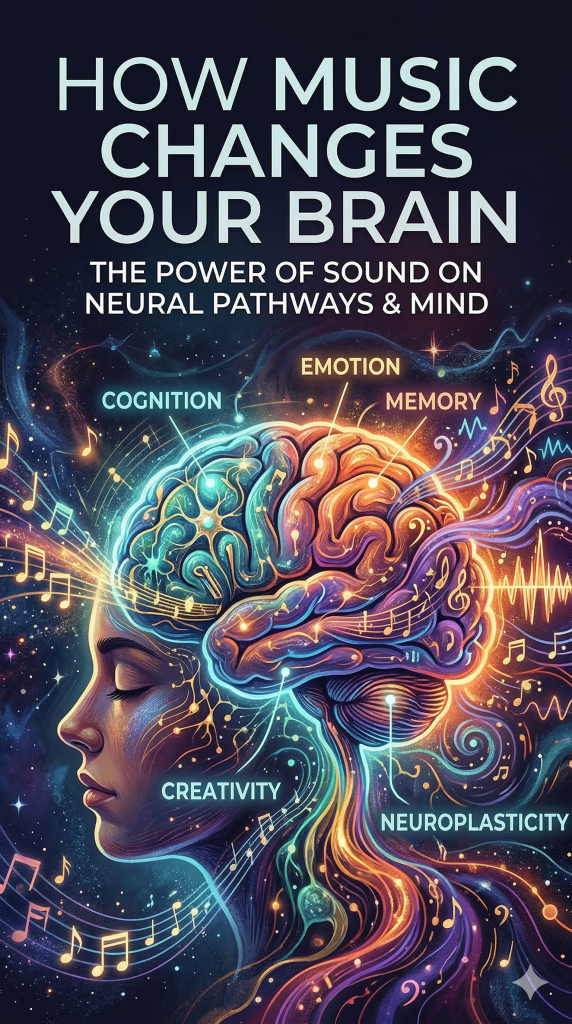
Of all the things humans have invented, music might be the strangest. It serves no obvious survival purpose — and yet every known human culture in history has made it. That alone suggests something important is going on.
Neuroscientists who study music have found it to be one of the most demanding cognitive activities the brain engages in. Listening to music activates the auditory cortex, the motor system, the emotional centers, the memory regions, and the prefrontal cortex — all simultaneously. Playing an instrument activates even more. Brain scans of professional musicians show structural differences compared to non-musicians, including a larger corpus callosum — the bridge between the brain’s two hemispheres.
Music’s effect on mood is not just subjective. It’s biochemical. Listening to music you love triggers dopamine release, the same reward chemical activated by food, exercise, and social connection. The anticipation of a musical moment — a beat drop, a chorus you know is coming — can trigger dopamine even before the moment arrives. That pleasurable chills-down-the-spine sensation, called “frisson,” is a measurable neurological event.
There are also practical applications. Music with a tempo around 60–80 beats per minute has been shown to reduce anxiety and lower heart rate. Upbeat music improves physical performance during exercise. Classical music, particularly Mozart, has been associated with short-term improvements in spatial reasoning — though this effect is more modest than the popular “Mozart effect” myth suggests.
What isn’t a myth: music is deeply, measurably good for the brain. Press play more often.
 Writerz Block
Plaats een reactie