Written by :Jan Vranken
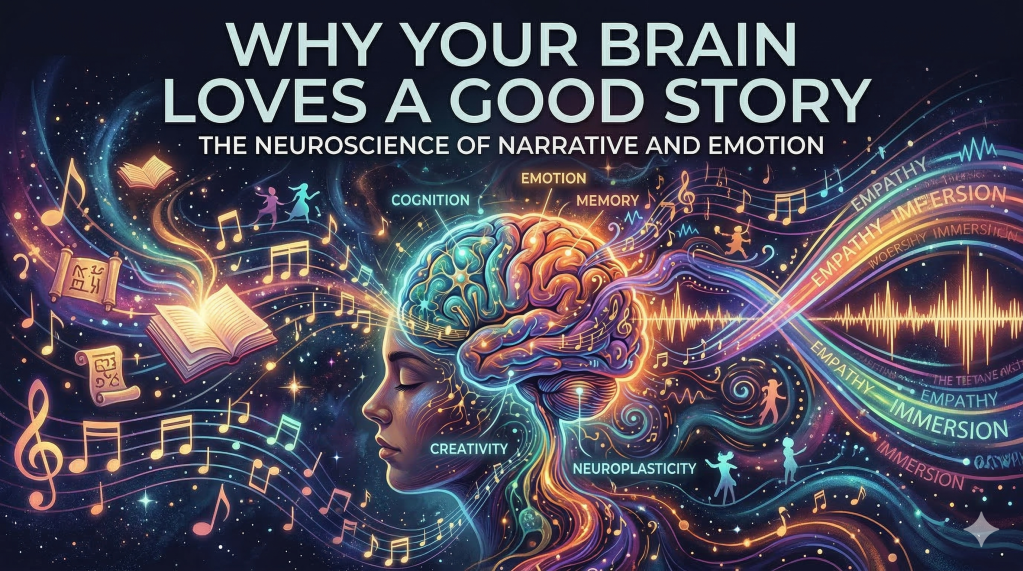
Humans have been telling stories for over 30,000 years — long before writing, books, or the internet. But why are we so drawn to narratives?
When you read a fact, only two areas of your brain activate: the language processing centers. But when you read a story, your entire brain lights up. The motor cortex fires as if you’re physically doing what the character does. Your sensory cortex responds to smells and textures described in the text. Your brain, quite literally, lives the experience.
This is why a statistic rarely changes behavior — but a well-told story often does. Charities know this. Marketers know this. Great leaders know this.
There’s also a chemical reason. Stories trigger the release of oxytocin, the “bonding hormone.” It’s the same chemical released when you hug someone or feel trusted. A gripping narrative makes you feel connected to characters who don’t even exist.
Researchers at Princeton found that a speaker’s brain and a listener’s brain actually sync up during storytelling — a phenomenon called “neural coupling.” The better the story, the stronger the sync.
So the next time you find yourself unable to put down a book at midnight, don’t blame yourself. Blame 30,000 years of evolution.
 Writerz Block
Plaats een reactie